Blog
AI Resume Screening: What Systems Look For and How to Win


The Invisible Gatekeeper: AI Resume Screening
The problem isn’t always your experience – it’s whether the system recognizes it.
Millions of qualified candidates are filtered out by hiring systems before a recruiter ever sees their resume. (Harvard Business School and Accenture)
And before your resume reaches a human, it is first screened by an ATS-used by over 98% of Fortune 500 companies (Jobscan)
AI tools for resume screening now act as the first layer of evaluation before any human review.
Even if the resume lands on the recruiter’s table, within 6 to 8 seconds your career story is either noticed – or discarded. (TheLadders).
Hiring has become faster-and more unforgiving.
Understanding how AI screens resumes-and where it falls short-is no longer optional.
Why Recruiters Use AI tools for Resume Screening
Recruiters are drowning under a mountain of resumes.
Within days, a single job posting attracts hundreds of applications. Reviewing every resume manually is not practical-it’s time-consuming.
This is where AI steps in.
It filters resumes based on predefined criteria-skills, experience, and alignment with the job description.
This reduces the manual workload and helps recruiters focus on a smaller, more relevant pool of candidates.
It also brings consistency. Instead of relying entirely on subjective judgment, the same criteria are applied across all applications.
For most organizations, this shift isn’t about efficiency alone-it’s about building a fairer, more scalable hiring process.
How AI Screens Resumes
When flooded with resumes, AI steps in to bring some order to this chaos, working across different layers:
- Keyword Matching
Think of this as the first filter. The system looks for words that match the job description. If those words aren’t found, the resume may not make it past the gate. - Resume Parsing
Here, AI pulls out the details-education, work history, skills-and organizes them neatly. Resumes with clear formatting and standard headings are much easier to process.
- Contextual Scoring
This is where things get smarter. The system tries to judge how relevant a candidate is by looking at their experience and skills in relation to the role. But the catch is, different tools interpret this differently.
- AI Summarization
Some platforms even create short summaries of resumes. This helps recruiters get the gist of a profile quickly, without reading every line.
These layers together shape how AI tools for resume screening evaluate candidates.
What Actually Happens When AI Screens Your Resume
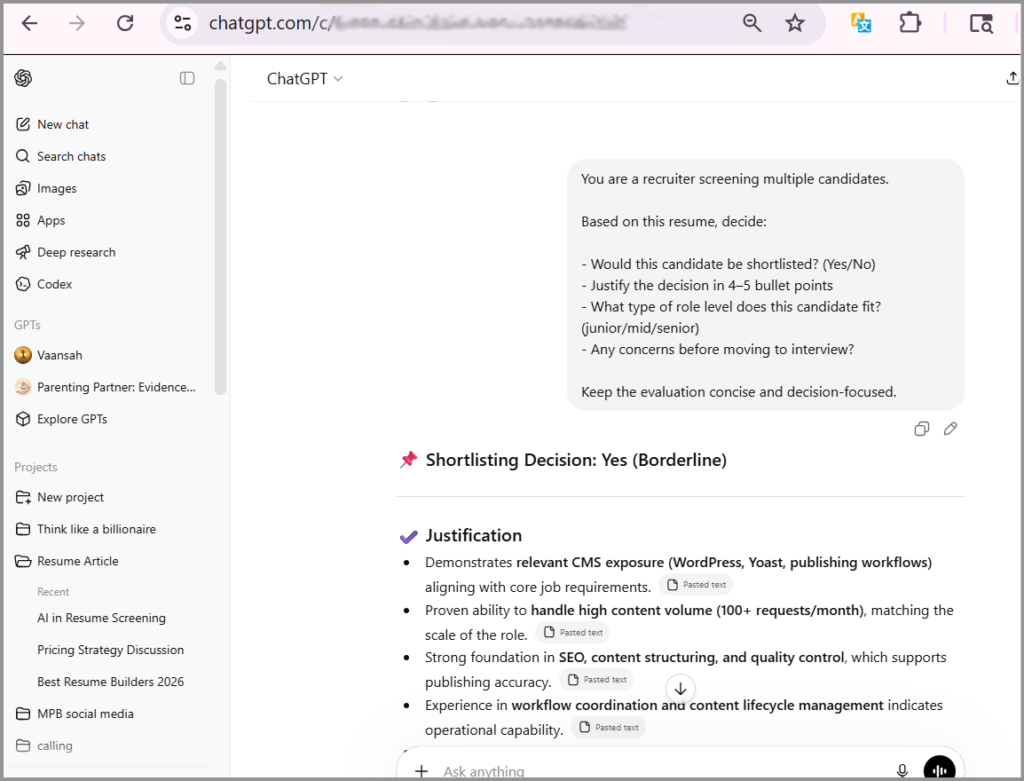
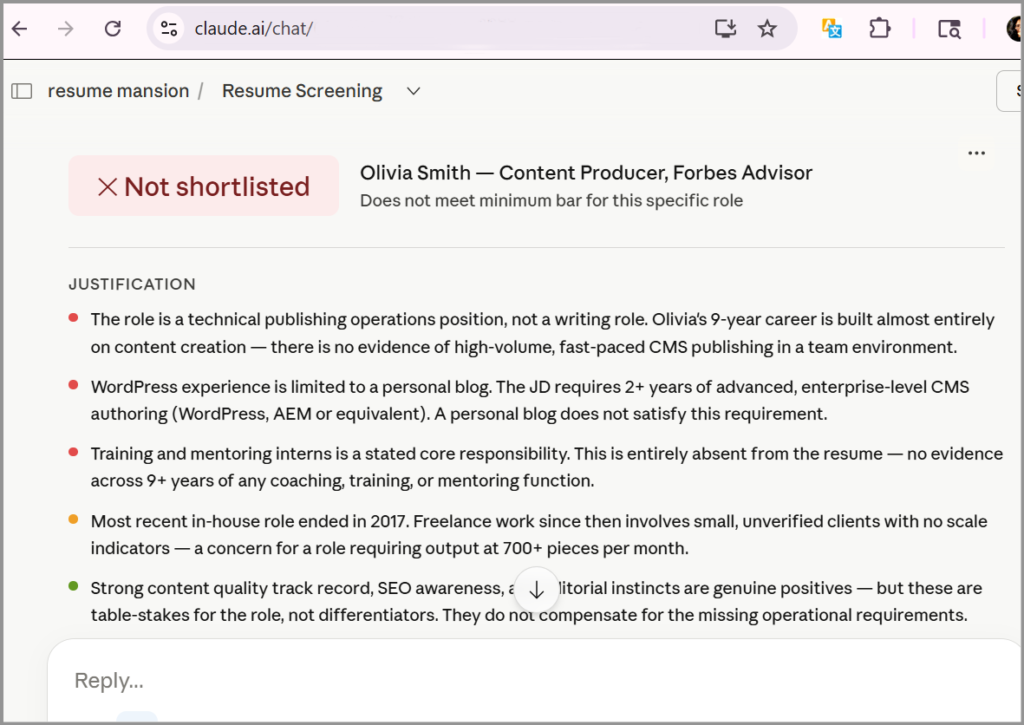
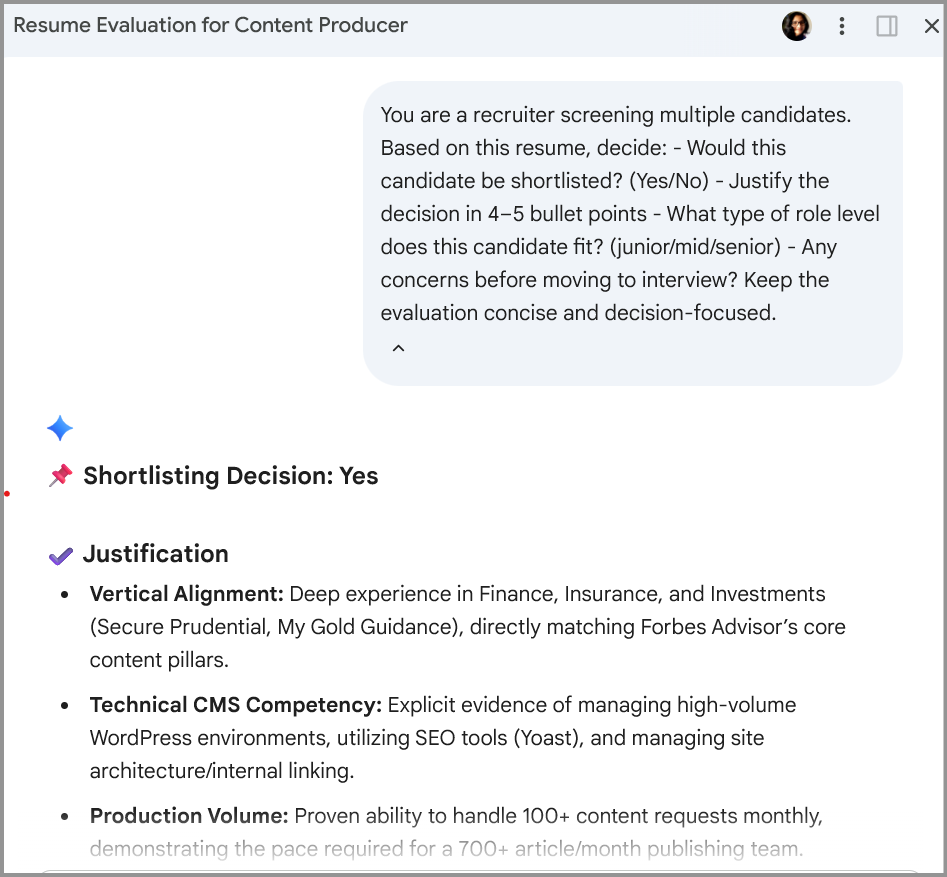
To understand how AI tools for resume screening work in practice, the same resume-created for a content writer role-was evaluated across multiple tools, including ChatGPT, Gemini, Claude and ATS-style platforms like Jobscan, using a single job description as the benchmark.
What emerged was not alignment-but variation.
- Different Tools, Different Scores
Run the same resume through different AI tools and you will get entirely different results.
One rates the candidate as a strong fit. Another flags the same profile as “borderline”.
AI screening is not standardized – each system runs on its own logic. And that logic directly influences the outcome.
ChatGPT Shortlisting Decision: Yes (Borderline)
Claude Shortlisting Decision: Not Shortlisted
Gemini Shortlisting Decision: Yes
- Keywords Matter More Than Meaning
ATS systems are not reading your resume. They are scanning it for specific words.
Miss a term from the job description and your score takes a hit – even when your experience is completely relevant.
The hard truth? Your experience must not just exist. It must speak the system’s language.
- If You Don’t Spell It Out, It Gets Missed
It did not pick up leadership unless it was labelled clearly.
Hands-on tool experience went unnoticed without detailed descriptions.
Once these elements were clearly articulated, scores improved considerably. The experience had not changed at all.
Only the clarity had.
- Small Changes, Big Impact
Adding tool names or workflow-specific terminology led to a noticeable rise in score.
The candidate’s actual experience stayed identical – only its presentation shifted.
Yet that was enough to change the outcome entirely. That alone changes how you should think about your resume.
- Structure Influences Interpretation
Formatting is not just about aesthetics. It directly affects what the system sees.
Information placed under non-standard headings was not always picked up correctly – even when the content was right there.
How your resume is structured shapes what gets read and what gets missed.
- Same Resume, Different Decisions
The inconsistency does not stop at scores.
Some systems recommended shortlisting despite identified gaps. Others used those exact same gaps to disqualify the candidate.
In several cases, the issue was not the quality of the resume – it was how clearly the fit was communicated.
Even a strong profile can be filtered out if alignment is not obvious.
- What Gets Lost in Summaries
AI-generated, though efficient, comes at a cost.
A detailed career shrinks into a generic summary – and the real impact quietly disappears.
In some cases, the summary painted a different picture than the resume itself.
Not because the candidate was misrepresented. But because nuance rarely survives compression.
- Evaluation Is Not Fixed
One of the most revealing findings. The same resume, assessed under slightly different instructions, produced different results.
AI evaluations shift based on how they are framed.
Which means outcomes depend not just on the quality of your resume – but on the specific logic of the system reviewing it on that particular day.
So, What AI Gets Right
Let’s be clear: AI isn’t here to replace the human element of hiring; it’s here to scale it.
Fast processing, consistent screening, quick shortlisting – AI handles the volume well.
Without these systems? Managing hiring at scale would be a logistical nightmare.
So yes – AI works well as a filtering layer. It ensures that recruiters aren’t buried under a mountain of resumes and can actually focus their energy where it counts most.
Where AI Falls Short
But here’s the critical nuance-AI is great at spotting patterns, not at understanding them. It can read a resume, but it can’t always read the story behind it.
It struggles with:
- Context Misinterpretation
Non-linear careers confuse AI tools. What looks unconventional on paper is often the most interesting thing about a candidate.
- Lack of Depth
The technology can struggle to differentiate between surface-level keyword stuffing and genuine, measurable impact.
It sees what you did, but not necessarily how well you did it.
- Inconsistency
Same resume, different tools, different verdicts. One system calls you perfect. Another calls you unqualified. How is that a fair evaluation? - Positioning
AI cannot easily recognize how a candidate’s experience strategically aligns with a role. It scans for keywords. It does not read between the lines.
The result?
Even the strongest candidates are being overlooked-not because they lack the expertise, but because their experience hasn’t been “translated” for a machine reader.
These limitations highlight a key gap in how AI tools for resume screening interpret real-world experience.
At this point, a few obvious questions come up.
What Most People Ask at This Stage
- I have solid experience. So why am I not getting shortlisted?
Because experience alone isn’t enough. If your resume doesn’t clearly match the job description, it gets ignored.
- How do I know if my resume is ATS-friendly?
Most people don’t. Tools help, but a good score doesn’t always mean your resume is positioned well.
- Can I just use AI tools to fix it?
You can, but AI often gives generic suggestions. It doesn’t position your profile strategically.
- Why do different tools give different results?
Because each tool uses a different logic, making it hard to know what actually works.
- Is adding keywords enough?
No. Keywords help, but structure and clarity decide if
- How do I know if my resume is working?
It comes down to the right keywords, clear storytelling, and role-specific positioning. That’s where expert input helps.
Because at the end of the day, it’s not about beating the system. It’s about making sure your resume actually reflects your value clearly.
The Rise of AI-Generated Resumes
AI tools are now more accessible than ever. More candidates are using them to build, polish, and optimize their resumes – and it is quite evident.
Resumes are aligning better with job descriptions. Keywords are in the right place. Formatting is cleaner.
But scroll through a hundred AI-optimized resumes and you will notice something unsettling.
They are starting to sound increasingly similar.
Optimization has improved, without a doubt.
But differentiation? That’s quietly taking a backseat.
What Makes a Resume Effective Today
In an AI-driven hiring environment, effectiveness depends on striking the right balance.
To cut through the noise, a strong resume must:
- Integrate a dual-design structure that is easy for systems to read, and compelling enough for recruiters to care.
- Use role-specific language without sounding like a robot.
- Communicate impact – not just a list of responsibilities.
Anyone can write “managed a team.” Far fewer can articulate what changed because they did.
AI vs Professional Resume Writing
AI tools are fast, accessible, and good for a quick draft.
But “well enough” rarely lands interviews.
What they lack is depth – the kind that comes from truly understanding your career story and positioning it for a specific role. A professional writer does not just optimize your resume. They contextualize it.
One gives you speed. The other gives you a strategy.
The Human Advantage
AI can generate content. What it cannot do is interpret your career with intention.
Understanding where you have been, where you are headed, and how to frame that journey for a specific role – that requires human judgement.
Rather than simply listing, they position achievements for real impact, knowing what your industry-specific recruiter is looking for.
The difference between a good resume and the right resume is rarely about keywords. It is about how your story is told.
Where This Leaves You
AI is part of hiring now. That is not changing.
What can change is how your resume is written for that reality – clear, structured, and positioned for both the system and the recruiter.
Because getting past the AI resume screening filter is only half the battle. Being understood once you do is what actually matters.