Blog
ChatGPT, Gemini, or Copilot? An AI Resume Format Comparison That Raised More Questions Than Answers


One Question. Three AI Tools. One Suspiciously Similar Answer.
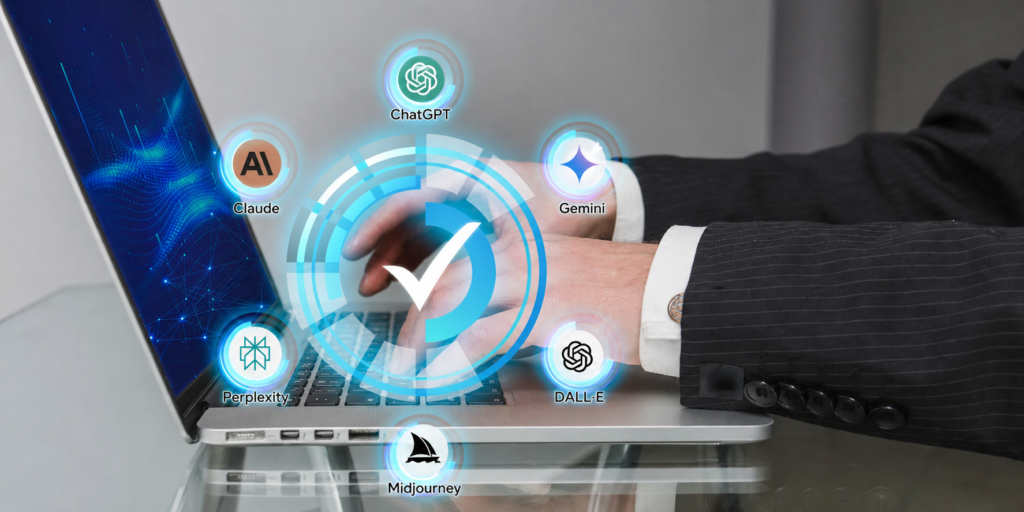
We decided to put that to a test through an AI resume format comparison involving ChatGPT, Gemini, and Copilot.
You Google “best resume format” and end up getting confused, for it floods you with information.
Reverse-chronological? Functional? Hybrid? ATS-friendly resume? Two columns or one?
Disappointingly, none of the advice is personalised to your situation.
So, no surprise job seekers are turning to AI for some personalised answers. That’s a quick, easy-peasy solution in 2026.
Asking AI for career advice has become almost second nature.
But does quick and easy mean better? Which one gives better advice?
Honestly, we expected some differences.
But the results were shockingly similar and enlightening at the same time.
AI resume format comparison: The Real-Life Experiment
Instead of being hypothetical, we tested this with a real-world challenge of a professional, Emma, who is a content writer with over a decade of experience.
She is a freelancer who has worked across multiple industries, and had taken a recent motherhood break. She desires to return to the workforce with a resume that feels both ATS-friendly and recruiter-friendly.
We asked the AI tools to suggest resume format, how to structure it, and how to handle the tricky parts in this real scenario.
Surprisingly, all three different tools arrived at almost the same conclusion.
Yet she still wasn’t sure how her final resume should look.
They all recommended a hybrid resume format.
Their reasoning was quite similar, the structure was identical too, and more so, the advice on managing career break, freelancing, design… all of it was so similar as if written by the same person but with a different approach.
Similar recommendations from the three tools left Emma with even more questions.
So, whom do you think Emma should trust?
ChatGPT Resume Recommendation: Practical & detailed.
It recommended ‘Hybrid’ resume format, common among all three tools.
The reasoning was quite straightforward. A chronological resume could draw immediate attention to Emma’s career break and on the other hand, functional ones might raise suspicion as to what was she hiding.
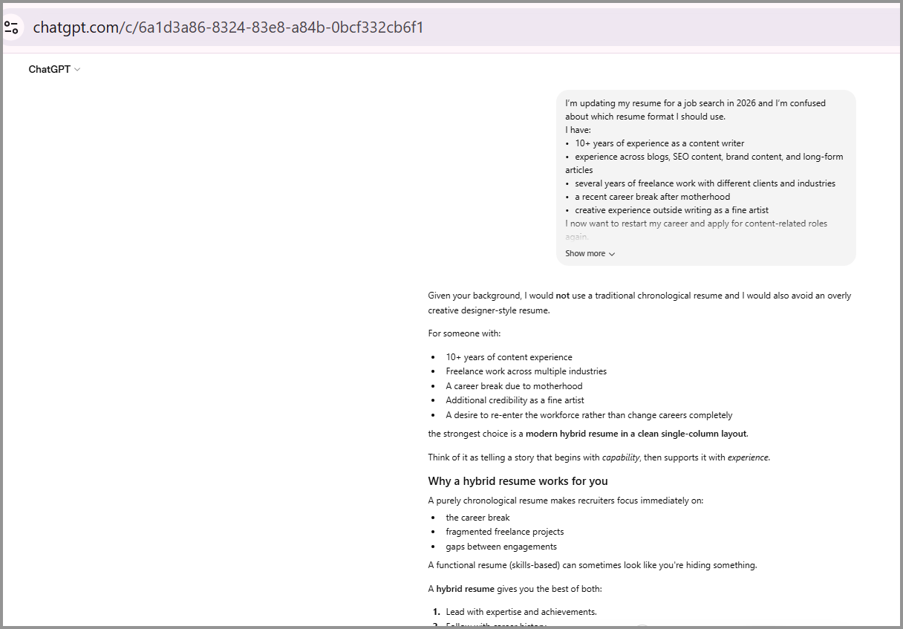
So, ChatGPT suggested that a hybrid structure will offer the best balance, showcasing both her expertise and transparent work history.
What stood out the most was the level of detail. ChatGPT walked through the resume section by section.
It advised Emma on how to present her motherhood break without apologising for it, and also how much of her resume should speak of her artistic experience.
To Emma, the response felt less like a search result and more like a conversation with a resume consultant.
Another useful recommendation was to showcase her freelance history as an umbrella entry, to prevent a fragmented appearance of her projects.
So, the overall advice was fairly practical, detailed, and highly focused on implementation.
Gemini Resume Format Recommendation: Empathetic coach
At first glance, Gemini’s recommendation sounded much like ChatGPT’s, but we found its approach slightly different.
It spent more time empathising Emma’s career story before moving into resume structure. Gemini felt like an empathetic coach who acknowledged her challenges of returning to work after a break.
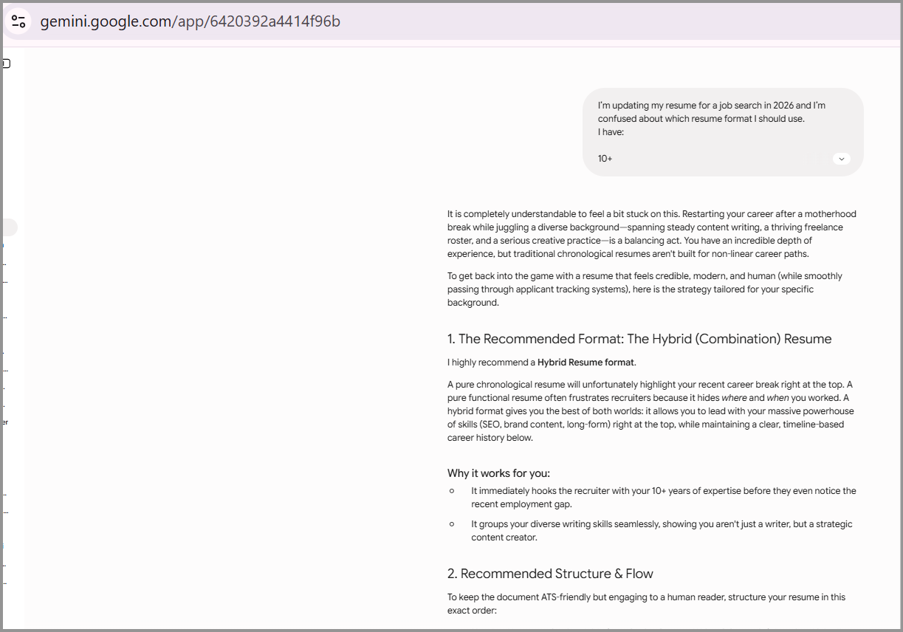
Gemini also explained why a chronological resumes struggle to represent non-linear careers.
It extensively guides on resume presentation, ATS compatibility, typography, colour usage, and document design.
Instead of focusing entirely on the content, it highlighted how right formatting decisions can impact the recruiter experience and ATS performance.
One more interesting point it put forth was to frame freelancing and caregiving periods as active phases of skill development rather than hidden gaps.
Overall Gemini’s response seemed reassuring especially when candidates like Emma feel uncertain after a life-changing break.
Copilot Resume Format Recommendation: A quick advisor
Like the other two tools, Copilot also recommended a hybrid resume format.
Copilot’s response was very concise, quick and efficient, but it spent less time exploring Emma’s unique situation.
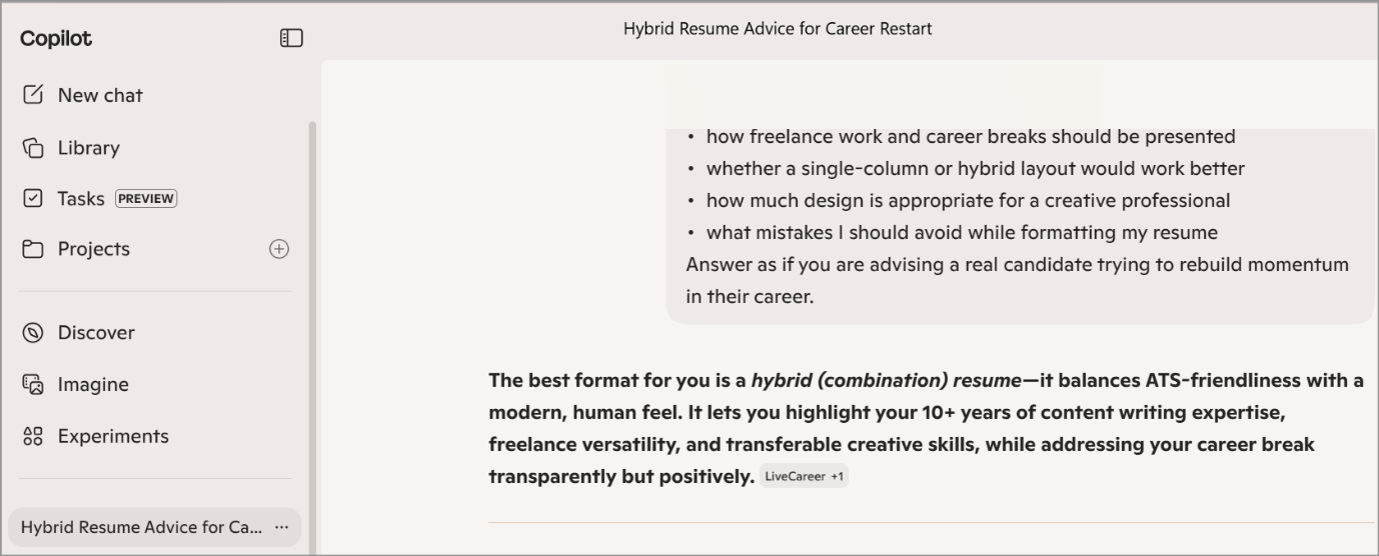
It did not dive deep into formulating a strategy. Instead, it focused on practical recommendations that Emma could implement quickly.
Copilot gave an overview of resume structure, ATS considerations, career break positioning, and design choices.
It is useful if someone needs a quick guidance, but someone looking of deep guidance can suffer from wondering how to implement this advice in their situation.
Now, that’s the difference between receiving information and knowing exactly how to use it.
Which resume format the AI Tools Agreed On – and What They Didn’t
What surprised us in this experiment was not the differences, but the similarities.
So quickly, here’s what the three tools commonly recommended:
- A hybrid resume format
- Gracefully handling the career break
- Grouping freelance work under a single heading
- Minimalist, ATS-friendly design
- Avoiding traditional chronology. Instead, leading with skills and expertise.
This AI resume format comparison revealed that the differences between the tools were far smaller than we expected.
| Tool | Resume Format Recommendation | Layout Preference | Career Break Handling | Design Guidance |
| ChatGPT | Hybrid (skills + history) | Clean, simple; leans single‑column | Brief, positive mention | Minimal, ATS‑friendly |
| Gemini | Hybrid (skills upfront, timeline below) | Strongly single‑column; warns against two‑column | Directly list as “Career Break – Caregiving” | Bold headers, dividing lines, max two colors |
| Copilot | Hybrid (balance ATS + creativity) | Hybrid layout; two‑column possible if careful | One‑line acknowledgment with transferable skills | Subtle creative touches, accent color, clean fonts |
The experience still raised an important question.
If all these sophisticated AI tools boil down at the same recommendation, why are so many job seekers like Emma still struggling to create effective resumes?
Well, the answer lies in the wide gap between advice and its practical application.
The Problem With Letting AI Make Resume Decisions
At first glance, it sounds pretty reassuring when we see the same recommendation across different AI tools.
And we tend to believe that these sophisticated tools agree on something, it must be right.
Or is it really?
So, we reviewed the responses thoroughly and found that the real challenge is not choosing the right format.
It is deciding what Emma’s resume should say about her.
All three AI tools commonly advised her to use a hybrid format, group freelance projects together, clarify the career break, and keep the design clean.
But what they could not answer is:
- Which of her achievements deserves the most space?
- Should her fine art background be highlighted or mentioned briefly?
- How should Emma position herself among the candidates with uninterrupted careers?
- Which freelance projects would impress a recruiter and which ones could be left out?
- What story should her resume tell?
This is the point where many job seekers get stuck.
So, it is easy to know the format. But knowing how to present yourself within that format is a whole new ball game.
Your resume is your first impression for recruiters, and not just a text with sections and bullet points.
Interestingly, how you prioritise information in your resume can drastically change how the recruiters perceive you.
For example, one candidate we worked with had nearly eight years of freelance experience, and she listed every client separately. She thought this would demonstrate her credibility and experience.
However, in reality, it made her career look fragmented and unstable. We restructured the information. We focused on outcomes and not individual projects.
Now, the same experience suddenly appeared far more credible and strategic.
We didn’t change the format dramatically. We just changed the positioning.
Another candidate had a similar concern to Emma. After a career break, she dedicated an entire section explaining the gap.
For her, the break was important, but for recruiters, her decade of experience was the decisive element of her resume.
It was not about hiding the break, but was more about making sure it didn’t become the headline of her professional story.
These are decisions that require context, judgement, and an understanding of recruiter behaviour.
And this is where AI reaches its limits.
So, AI was good at identifying patterns, suggesting structure, and even recommending best practices in Emma’s resume.
But it lacks the understanding of nuance behind Emma’s career journey.
On the other hand, professional resume writers don’t simply choose templates.
They help candidates identify their strongest selling points. They help you decide what part of your resume deserves emphasis, and address potential concerns, if any.
More so, they help you create a compelling narrative that aligns well with your specific career goals.
In short, it is not the format but the strategy behind it that helps you make an interview-winning resume.
Which naturally raises a few questions that AI tools struggle to answer.
Questions Job Seekers Ask That AI Can’t Fully Answer
How do I know if my resume is actually ready to send?
A resume is ready when it clearly communicates your value and is tailored to the role you’re targeting. Unfortunately, there is no universal checklist that guarantees success.
Should I focus more on skills or experience?
It really depends on your career story. For some, skills can help overcome a career gap, and for others, work history carries more weight. The challenge is deciding what deserves the spotlight.
How much of my career story belongs on a resume?
Surprisingly, not every accomplishment, project, or responsibility needs to be included. One of the hardest resume decisions is knowing what to leave out. A strong resume is often as much about editing as it is about writing.
What makes one candidate stand out when everyone is using similar resume formats?
Again, it’s not the format. It’s the clarity of the candidate’s positioning, the relevance of their achievements, and how effectively they communicate their value to employers.
The Final Takeaway From This AI Resume Format Comparison Experiment
This experiment revealed something unexpected.
The challenge wasn’t choosing between ChatGPT, Gemini, or Copilot.
It was knowing what to do with the advice once we received it.
In this AI resume format comparison, we saw all three tools largely agreed on the format.
They recommended similar approaches to handling freelance work, career breaks, and ATS-friendly design.
Yet despite receiving almost identical recommendations, Emma still wasn’t sure how her final resume should look.
And that is the most important lesson of all.
The biggest challenge in resume writing is not choosing the right format.
It is deciding how to present your unique career story within that format.
AI tools can be excellent starting points. They can provide direction, structure, and useful guidance.
But when it comes to understanding career breaks, positioning your experience, highlighting the right achievements, and creating a resume that genuinely stands out, human judgment still matters.
Because at the end of the day, recruiters do not hire formats. They hire people. And the strongest resumes are the ones that tell their story well.
Read More:
- How to get your resume past the ATS
- How to create an ATS-friendly resume
- How to use keywords effectively in your resume to land more job interviews